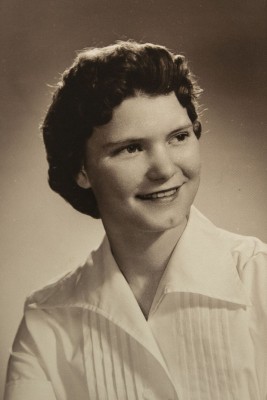
Lucille “Lucy” Elaine DeVries (Courtesy Mason City Globe Gazette)
Lucille Elaine DeVries
Homicide
Case information provided by the Iowa DCI and Mason City Globe-Gazette
RECENT UPDATES
The Globe Gazette’s Molly Montag spoke with Lucille DeVries’ surviving family members for an article published Sept. 6, 2015, as part of “Gone Cold,” a weekly feature highlighting some of Iowa’s unsolved homicides in the hopes it will lead to new tips and potentially help solve cases.
The project is a partnership between Iowa Cold Cases and the Iowa Newspaper Association, along with participating Iowa newspapers, including the Globe Gazette.
Read the story and see updated photos here.
Lucille Elaine DeVries, a 22-year-old insurance firm secretary and restaurant waitress, was found dead early Wednesday, Oct. 10, 1962, in the back seat of her fire-gutted auto outside her Mason City, Iowa home.
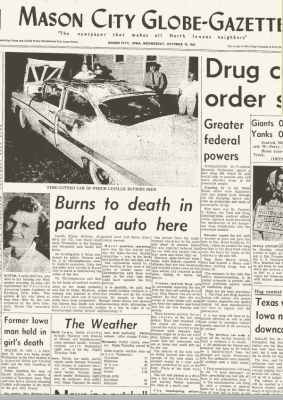
Courtesy Mason City Globe-Gazette,
Oct. 10, 1962
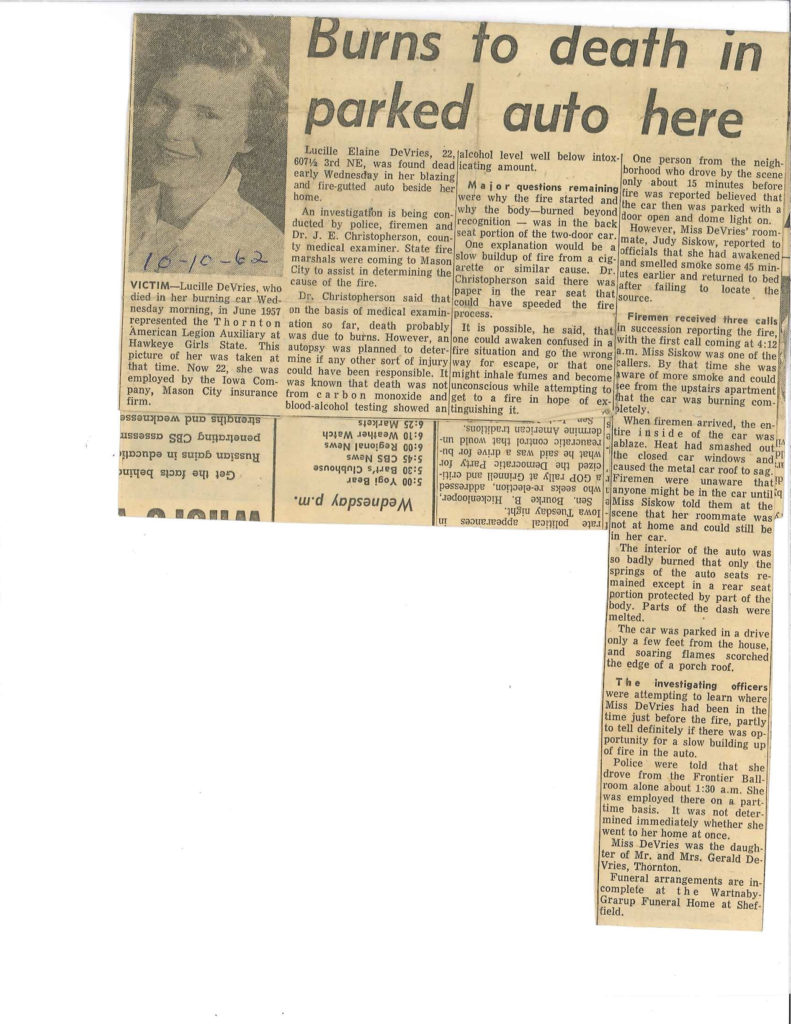
According to a Mason City Globe-Gazette article dated Oct. 10, 1962, DeVries’ roommate, Judy Siskow, told officers she awoke shortly after 4 a.m. and smelled smoke. She said she saw Miss DeVries’ burning car parked outside in the driveway beside their 607 Third Street NE apartment and called firemen.
Fire Chief A. Boyd Arnold, the Mason City police and Dr. J.E. Christopherson, county medical examiner, conducted the investigation, and called in state fire marshals to assist with determining how the fire started.
According to the Globe-Gazette, there were major questions as to how the fire started as well as why the body — burned beyond recognition — was found in the two-door vehicle’s back seat.
Christopherson conducted the autopsy that day.
The Globe-Gazette report also stated:
Firemen received three calls in succession reporting the fire, with the first call coming at 4:12 a.m. Miss Siskow was one of the callers. By that time she was aware of more smoke and could see from the upstairs apartment that the car was burning completely.
When firemen arrived, the entire inside of the car was ablaze. Heat had smashed out the closed car windows and caused the metal car roof to sag. Firemen were unaware that anyone might be in the car until Miss Siskow told them at the scene that her roommate was not at home and could still be in her car.
The interior of the auto was so badly burned that only the springs of the auto seats remained except in a rear seat portion protected by part of the body. Parts of the dash were melted.
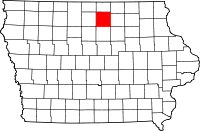 Cerro Gordo County in Iowa
 Mason City in Cerro Gordo County
The car, the Globe-Gazette reported, was parked in a drive only a few feet from the house, and soaring flames scorched the edge of a porch roof.
One of nine children who grew up on the family farm a few miles outside Thornton, “Lucy” was described by her siblings as something of a tomboy. After graduating high school she’d initially gone to a professional school in Omaha but later returned to Mason City and took a job with The Iowa Co., an insurance agency.
DeVries also worked part-time at the Frontier Club and Ballroom, and had started her waitressing shift Tuesday night at 6 p.m. Her shift ended at 1:30 a.m. Wednesday, at which time she’d driven to the Wheel Inn Cafe and dined alone. Witnesses said she’d left the restaurant at approximately 2:45 a.m.
Cause of Death Leaves More Questions than Answers
In his autopsy report, Dr. Christopherson ruled cause of death as burn injuries, but didn’t determine whether DeVries was already dead before the fire was set.
Though DeVries had suffered some smoke inhalation, Christopherson said she had not suffered carbon monoxide effects to a point that alone would have caused her death, the Globe-Gazette reported Oct. 11, 1962.
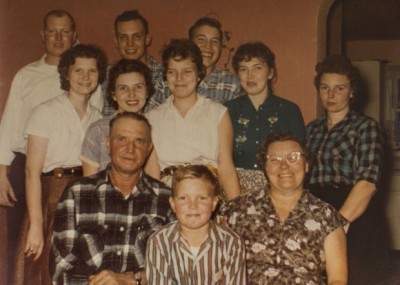 Courtesy CHRIS ZOELLER, The Globe Gazette
The DeVries family is pictured, from left: Front row, Bob DeVries; second row, parents Jerry and Lena Anna DeVries; third row, Lucy, Alvina, Mary, Mildred and Rose DeVries; back row, Don, Dick and John “Butch” DeVries.
Officials initially ruled DeVries’ death as accidental, but were dogged by unanswered questions.
Blood test results from the autopsy indicated DeVries was not intoxicated at the time of death, and there was nothing to indicate why she’d be disoriented and have climbed into the back seat rather than entering her home. She had no steady boyfriend and no known enemies.
Investigators interviewed more than 100 individuals in her death, and in February 1963 the fire chief announced they’d found no evidence contradicting Christopherson’s autopsy report.
The Feb. 16, 1963 story published in the Globe-Gazette also cited the following findings:
- No evidence existed of a concussion.
- DeVries had not suffered any skull fracture or broken bones.
- There were no indications of DeVries having been choked or smothered.
- Investigators could not definitively rule out foul play.
Forty-seven years later, when the Iowa Division of Criminal Investigation (DCI) established a Cold Case Unit in 2009, DeVries’ unsolved murder was one of approximately 150 cases listed on the Cold Case Unit’s new website as those the DCI hoped to solve using latest advancements in DNA technology.
Although federal grant funding for the DCI Cold Case Unit was exhausted in December 2011, the DCI continues to assign agents to investigate cold cases as new leads develop or as technological advances allow for additional forensic testing of original evidence.
The DCI remains committed to resolving Iowa’s cold cases and will continue to work diligently with local law enforcement partners to bring the perpetrators of these crimes to justice for the victims and their families.
Family members said they still have their suspicions.
Read more here about their September 2015 interview with the Gazette’s Molly Montag.
About Lucille DeVries
Lucille Elaine DeVries was born August 7, 1940 to Gerald R. “Jerry” and Lena Anna (Schroeder) DeVries.
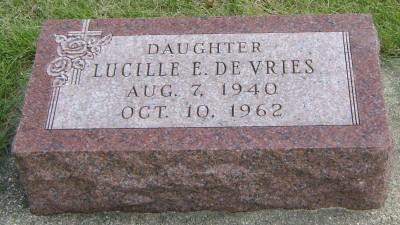 Courtesy photo Betsy Monson, findagrave.com
Lucille DeVries is buried at Pleasant View Cemetery in Thornton, Cerro Gordo County, Iowa.
In addition to her parents, she was survived by four sisters, Rose Springer, Mildred Jensen, Mary DeVries, and Alvina Muhlenbruch; and four brothers, Don, Richard, John, and Robert DeVries.
Prayer services were held on Friday, Oct. 13, 1962, at the Wartnaby-Grarup Chapel in Thornton with funeral services afterward at St. John’s Methodist Church.
Lucille was buried in Pleasant View Cemetery in Thornton, Iowa.
Information Needed
Anyone with information regarding Lucille DeVries’ unsolved murder is asked to contact the Iowa Division of Criminal Investigation at (515) 725-6010, email dciinfo@dps.state.ia.us, or contact the Mason City Police Department at (641) 421-3636.
Sources:
- IOWA DIVISION OF CRIMINAL INVESTIGATION, former Cold Case Unit, Dec. 13, 2009
- Mason City Police Department
- Lucille Elaine DeVries — Find A Grave Memorial
- “53 years later, North Iowa siblings still mourn sister, seek answers,” by Molly Montag, Part of the GONE COLD: EXPLORING IOWA’S UNSOLVED MURDERS series, The (Mason City) Globe Gazette, Sunday, Sept. 6, 2015
- “Unsolved Iowa killings: friends ‘still feel scars’,” by Nick Lamberto, The Des Moines Register, Sept. 8, 1974
- “List of ‘case open’ slayings in Iowa,” Des Moines Register, Sept. 8, 1974
- “No Conclusions after 4-month investigation in DeVries death,” by James R. Owens, The Mason City Globe Gazette, Feb. 16, 1963
- “No new clues in fire death,” The Mason City Globe Gazette, Feb. 8, 1963
- “Mason Cityan’s death ruled accidental and due to fire,” The Mason City Globe Gazette, Oct. 11, 1962
- “Burns to death in parked auto here,” The Mason City Globe Gazette, Wednesday, Oct. 10, 1962
- “Iowa Woman Found Dead in Burning Car,” The Cedar Rapids Gazette, Wednesday, Oct. 10, 1962


Found in the back seat. Not intoxicated. In her driveway. I suspect someone followed her home and blitz attacked her and she was dragged in the back seat to be assaulted. Then killed eventhough no evidence was found to support that it majes sense. And the car set on fire to cover up the crime. It was successful.
Bob, there are times officials purposely don’t disclose particulars about a case because it might compromise the investigation. This often pertains to details that only the killer would know. The case is included here because it’s one the Iowa Division of Criminal Investigation’s Cold Case Unit had included on their website when the CCU was still up and running — along with Lucille’s case number and a link where one could send tips to the DCI specifically for this case. The tip links for each of the DCI’s cold cases ceased to work once the DCI deleted the cold case unit section from their website.
Even while the pages were still active, the DCI did not offer any explanation as to why the case was ruled a homicide rather than an accidental death.
What is it about this case that indicates homicide rather than accidental?