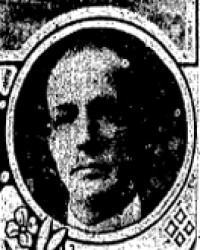
Thaddeus mitchell

Thaddeus Mitchell

Thaddeus William Mitchell

Homicide


Thaddeus William “Thad” Mitchell
44 YOA
St. Joseph Avenue near 20th Street
Des Moines, IA
Polk County
December 7, 1922

Polk County in Iowa
Polk County in Iowa
Des Moines map
Des Moines in Polk County


By Nancy Bowers
Murder Near the Pest House

In 1922, there were few places in Des Moines more remote than St. Joseph Avenue.

The street, no longer existing, dead-ended at Crocker Woods. At that spot was a brick yard to the north, a gravel pit to the south.

Between those operations stood one of the most feared places in Des Moines: the City Detention Hospital, known as the “Pest House,” where citizens with TB and other communicable diseases were made to live in isolation from others.

The area was little traveled and much avoided, so it was a perfect “Spooners’ Lane” where lovers and others with secrets could be assured privacy.

On the morning of December 8, 1922, former Des Moines Policeman William Winburn, who lived at 1802 St. Joseph Avenue in one of the area’s few homes, saw something curious when he woke and looked out at the street.

At the bottom of a steep incline coated with early-winter ice was a five-passenger Cadillac sedan. The front of the car pointed southeast and the wheels were up over the curb, only a few feet from a deep ditch.

Mitchell crime scene map Courtesy photo Des Moines Capital
Map of the Mitchell crime scene near the Pest House.

Sensing something wrong, Winburn summoned the Des Moines Police, who arrived quickly but had difficulty reaching the car because of the icy pavement.

Slumped over the steering wheel of the Cadillac — a five-passenger taxi cab — was a dead man, shot in the shoulder and arm, with powder burns indicating point-blank range. On the seat were empty .32 caliber automatic pistol cartridges.

The gears were in reverse and the engine had died when the man’s foot eased off the accelerator.

Inside the taxi were a bottle cork, a woman’s rubber overshoe, and a man’s handkerchief. On the ground nearby was a ladies black hat.

Mitchell death car Courtesy photo Des Moines Capital
The arrow points to where Mitchell’s body was found in his Cadillac taxi.

The dead man was of medium height and weight with blue eyes and light brown hair. He wore a watch and other jewelry and carried a large roll of bills.

The victim was identified as Thaddeus William “Thad” Mitchell, 44, an independent taxi driver in partnership with O.R. Richart. Mitchell and his wife Mary lived in the Bristol Apartments at 6th and Center streets.

The meter on Mitchell’s taxi registered six miles, the distance from his taxi stand near 5th and Locust in downtown Des Moines to the murder spot.

Employees of the Lafayette Café at 421 Locust Street, where Mitchell ran his stand, said he left with a fare about 11:00 p.m.

It appeared that when Mitchell’s taxi started sliding down the icy incline of St. Joseph Avenue, he stopped it by turning the wheel sharply and driving over the curb. When he put the car in reverse to turn around, he was shot.

1921 Cadillac

An ad for a Cadillac five-passenger
sedan like Thaddeus Mitchell's taxi.


Mitchell’s death was one of many violent events in the heady and crazy — and often dangerous — world of 1920s Des Moines nightlife.

The Post-War Years

Des Moines saw a huge influx of population and industry during WWI. The Cantonment at Camp Dodge brought thousands of men and jobs to the area.

Thaddeus Mitchell, in fact, ran a thriving taxi business with six sedans that operated strictly in and out of Camp Dodge during the war years.

The 1920s were a boom time as well: the War to End All Wars was won, the economy was fine, women could vote, and everyone wanted to have a good time.

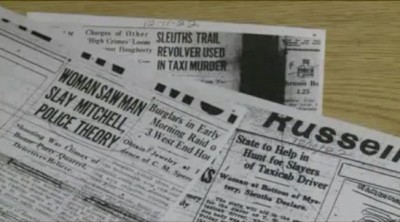
WHO-TV Channel 13′s Aaron Brilbeck reports on the Roaring 20s and the unsolved murder of Thaddeus Mitchell. December 2, 2010

There was just one obstacle: the Eighteenth Amendment prohibiting the manufacturing and sale of alcohol nationwide went into effect on January 17, 1920.

Iowa, however, had been “dry” since 1916, giving the state a head-start on evading prohibition laws. Iowans knew how to make, sell, buy, and imbibe strong drink.

During Prohibition, bootlegging was a profitable Iowa business. Corn, a key ingredient in “moonshine,” was always available.

The state’s rural nature provided isolated locations for making liquor; bootleggers concocted their booze in remote barns, chicken coops, and hog houses.

Local grapevines conveyed information about which basement, garage, or outbuilding sold liquor.

The state was best known for Templeton Rye, a reddish-orange liquid brewed in Carroll County that was consumed not only in Iowa but was also shipped to Chicago, Kansas City, and other large Midwestern cities.

Made without any safety regulations or standards, almost all the moonshine was dangerous to drink. It could cause blindness, brain damage, paralysis, and death.

Danger was ever-present, also, because of thugs and gangsters attracted to the illegality and profitability of liquor sales. Headlines in Des Moines newspapers cataloged the violent events that unfolded around the activity.

Alcohol was available everywhere in Iowa, making enforcement of the prohibition laws nearly impossible. As soon as one juke joint or speakeasy on the outskirts of a city or town was shut down, another popped up.

Taxi Parties

To avoid “raids” where they might be caught, drinkers hired taxis driven by men who knew where alcohol could be purchased and who allowed consumption of liquor inside the car.

These taxis took passengers to out-of-the-way roadhouses, waited till they came out, and drove them back to the city. These outings were called “taxi parties.”

Thaddeus Mitchell, who moved to Des Moines about the time Iowa went dry in 1916, ran a party taxi.

Shortly after Mitchell’s murder, the Des Moines Capital reported, “Police have a theory that the shooting followed a drunken party in the taxicab.”

Newspapers reported that a few weeks before his death Mitchell turned over his taxi — filled with partiers — at the corner of Forest and Beaver avenues, causing 500 dollars damage to the car.

Mitchell taxi stand location Courtesy photo Cowles Library
The location of Thaddeus Mitchell’s taxi stand on Locust, looking west from 5th Street.

On the night of the shooting, Mitchell’s taxi was likely booked by party-seekers at his stand in downtown Des Moines and he drove them to buy liquor. St. Joseph Avenue, the secluded lovers’ lane, offered a spot for the party to drink unobserved.

Only the passengers knew what happened when Mitchell’s taxi turned east from 20th Street on to St. Joseph Avenue and skidded down the icy hill.

Perhaps Mitchell was lost or decided to go home and was turning around. Maybe he failed to find a roadhouse or source of alcohol. The passengers may have refused to pay the fare.

Whatever happened, a gun went off and Mitchell was killed.

The Investigation

At 8:30 a.m. on December 8, Polk County Coroner Guy E. Clift took charge of the case and ordered the body and crime scene kept intact for a preliminary investigation.

Assistant Chief of Detectives James MacDonald worked the murder with the assistance of state Bureau of Criminal Investigation agents.

Mitchell’s wife Mary said she last saw her husband at 6:00 Thursday night, when he said he’d be home by midnight. She said he never mentioned enemies but she acknowledged many people knew he carried large amounts of money.

Mitchell also told his wife he was quitting the taxi business because its hours and other demands made it “no business for a married man.”

The Motive

Because Mitchell’s money and jewelry were not stolen, robbery was an unlikely motive unless the assailant panicked after the shots and fled without rifling Mitchell’s pockets.

Acquaintances said Mitchell was popular with his fares but was stubborn, non-committal, and unemotional. Once he threatened to inform the wife of a party customer who refused to pay his fare.

The woman’s overshoe inside the car and ladies hat near the taxi suggested a woman was involved.

Police, however, could not prove Mitchell was romantically entangled with any women he drove on taxi parties. According to the Des Moines Capital:

“Numerous women whom Mitchell had as ‘fares’ to outlying roadhouses, when questioned by the detectives, stated emphatically that Mitchell ‘never mixed in’ on any of the parties, but waited till his passengers were ready to return to the city. They also testified that Mitchell never drank with them and that he invariably attended strictly to his own business.”

Detective MacDonald placed no significance on the female clothing, telling the Capital that the taxi was a public conveyance where items might have been dropped by any woman passenger before the shooting. He pointed out a collection of handkerchiefs in one of the door pockets, all left behind by fares.

MacDonald had an unusual theory about the gender of the killer and argued it was not a woman because the fatal shots were fired from behind.

He stressed it was a “recognized female trait” for a woman — for example, over-wrought with jealousy — to face her victim so he knew who was killing him.

Mitchell’s Partner O.R. Richart Believed Missing

The morning after the murder, Mitchell’s partner O.R. Richart was reported missing. The custodian of his apartment building at 1602 Locust Street said Richart had not been home since 9:30 the before night and his bed was not slept in. Nor was he at his taxi stand in front of the Hotel Savery.

However, police learned that earlier on Friday a man believed to be Richart phoned Beattie Garage at 812 Mulberry and asked them to tow a Cole Arrow that was wrecked on Merle Hay Road the night before.

Richart was found alive and his activities on Thursday night were unrelated to the murder of his partner Mitchell.

Because Richart always drove a Cadillac, rumors circulated that the wrecked Cole Arrow belonged to an Ames man named Nelson who frequently went on taxi parties with Richart.

After the account of Richart and Nelson appeared in the Des Moines Capitol, the newspaper was pressured to print this statement on December 12:

“Developments in the Mitchell murder case make it clear that the name of John I. Nelson of Ames should not have been linked with the mystery in a way unfavorable to him. It was particularly an error to make it appear that he comes to Des Moines from time to time for taxi parties with Richart. There is no evidence to give support to such an intimation. Mr. Nelson is a reputable business man of Ames, and many business friends of Des Moines also vouch for him in every way.”

No Answers for the Murder

The Des Moines Capital termed the Mitchell murder “one of the most baffling in the annals of Des Moines criminal history.”

Clues were numerous but none led to answers. Detective MacDonald, in fact, said the case grew “more puzzling” with every new lead.

It was rumored that two witnesses to the shooting would be brought in, but that did not materialize.

The state of Iowa posted a 500 dollar reward for information. Kruidenier Cadillac dealership, where Mitchell obtained his taxies, offered 100 dollars towards the reward fund; and Rell and Press taxi companies chipped in 50 dollars apiece.

No suspects could be found and the case eventually went cold.

Murder: Did it Run in the Family?

For the authorities and for Mitchell’s family, there was a strange sense of familiarity about the murder.

On Saturday, May 1, 1920, Mitchell’s brother-in-law David Faulkner (the brother of Mary Mitchell) was murdered in his home at 2615 Lyon Street in Des Moines.

His wife said she found him dead when she returned from a movie. He was strangled with his own necktie and bludgeoned to death from behind while reading in a chair.

Neither man was robbed, although the Faulkner murder scene was ransacked to make robbery appear to be the motive; and neither man was known to have enemies.

The Life of Thaddeus Mitchell

Thaddeus William Mitchell was born October 1, 1878 in Searsboro, to Ellen Josephine Cooper and Union Civil War veteran John S. Mitchell.

He had two siblings — Benjamin Arthur Mitchell and Louisa Ella Mitchell Baker — as well as a half-sister, Blanch Flemming.

About 1901, he married Mary Elizabeth Faulkner. The couple, who had no children, moved to Des Moines in 1916.

Thaddeus Mitchell was buried near his family in a Searsboro cemetery.

Information Needed

Questions and information about the unsolved 1922 murder of Thaddeus William Mitchell or the unsolved 1920 murder of David Faulkner should be directed to the Des Moines Police Department at 515-283-4864 or to Iowa Cold Cases through the Contact form.

Sources
  • “Air of Secrecy Marks Mitchell Murder Search,” Des Moines Capital, December 12, 1922.
  • “David A. Faulkner,” Des Moines Daily News, May 8, 1920.
  • “Five Murders In Last Year Is Des Moines Lowest Record,” Des Moines News, December 12, 1920.
  • “Increase Reward In Mitchell Case,” Des Moines Capital, December 22, 1992.
  • “Mitchell Murder May Join Ranks of Unsolved Crimes,” Des Moines Capital, December 10, 1922.
  • “O.R. Richart, Mitchell Chum Also Missing,” Des Moines Capital, December 8, 1922.
  • “Probe Murder,” Des Moines Daily News, May 3, 1920.
  • “State Joins Taxi Murder Investigation,” Des Moines Capital, December 10, 1922.
  • “Taxi Driver Slain In ‘Spooners’ Lane,’” Des Moines Capital, December 8, 1922.
Tagged with:
 

Add a Comment

2 Responses to Thaddeus Mitchell

  1. Christine (Beattie) Stipe says:

    Well…!!
    I must say I’m intrigued by this article!!….
    “Beattie Garage” was owned by my Great Grandfather!!
    I’ve been researching my family history since I was a teen & occasionally I do random searches online to see if I can stumble upon anything new….low & behold, I just found this article!!….
    Was Thaddeus’s killer ever found? Other than threatening to tell the wife of a party customer, & since he wasn’t robbed….what possibly could have been the motive??…..Interesting story to add to the family history, but sad if it is still a cold case, given that it was nearly 90 years ago, it’ll probably never be solved and Thaddeus’s family will have no closure : (

    • Nancy Bowers says:

      Thanks for leaving a comment, Christine. We appreciate your interest in Iowa Cold Cases.

      So glad you were able to add a little bit to family history and lore from the Mitchell Case Summary.

      No, the murder was never solved. Likely, the shooting was a combination of anger and alcohol.

      All best,
      Nancy Bowers, Co-Administrator
      Iowa Cold Cases

Leave a Reply

Your email address will not be published. Required fields are marked *

*


*

You may use these HTML tags and attributes: <a href="" title=""> <abbr title=""> <acronym title=""> <b> <blockquote cite=""> <cite> <code> <del datetime=""> <em> <i> <q cite=""> <strike> <strong>