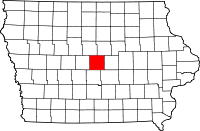
Story County in Iowa
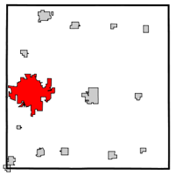
Ames in Story County

Henry William Chavis

Homicide

Henry William Chavis
55 YOA
Highway 69
One mile south of Ames, IA
Story County
November 8, 1948

Case summary by Nancy Bowers

In the early hours of Monday, November 8, 1948, 55-year-old Ames businessman Henry Chavis was gunned down behind his rural Story County home.

For decades, this unsolved murder has baffled and intrigued area residents.

The Ames Historical Society receives more queries about the Chavis murder than almost any other historical event, even though the jurisdiction of the case is Story County rather than Ames.

Theories and suspects were plentiful in 1948, but no one was charged or brought to justice.

The Canning Czar
Courtesy photo Ames Historical Society
The Chavis family about 1938, L to R: Doris Chavis Rehnblom and her husband Carl Rehnblom, Henry, Gertrude, and Loreyne.

In 1936, Indiana resident Henry Chavis bought the Ames Canning Company. He moved his wife Gertrude and daughters Doris and Loreyne to Ames and the family lived on Duff Avenue, a tree-lined boulevard with large, impressive homes.

Soon after moving to Ames, Henry Chavis became one of the premiere businessmen in the city.

Hundreds of local residents were employed by the Ames Canning Company, which opened in 1918 to process corn and sent most of its products that year to feed U.S. troops fighting in WWI.

After buying the operation, Chavis expanded the company’s products and sped up the process until the factory could turn out two hundred and forty cans per minute.

Courtesy photo Ames Historical Society
Henry Chavis purchased the Ames Canning Company in 1936.

The company canned and distributed the brands Ames, Iowana, Collegian, Lulu Belle, and Pride of Ames.

During WWII, chicken was canned to send overseas as part of the Lend-Lease Act.

Moving to the Country

The immediate post-war years were very good for Chavis.

In 1946, the Chavises — whose daughters were then married — moved to a large farm one mile south of Ames in Washington Township of Story County.

The four-bedroom home was fully modernized and considered impressive for the times.

It sat on the west side of Highway 69, which Duff Avenue became as it left the then-city limits.

Photo by Neal Bowers
The rural farm home of Henry and Gertrude Chavis once stood at this busy corner, taken 2011.

Today, the location of the Chavis farm is within the Ames city limits in a bustling commercial hub at South 16th Street and South Duff Avenue, where Old Chicago Restaurant, Grand Stay Residential Suites, and the former Benson Motors building are located.

In addition to running the canning company, Chavis farmed nearly 300 acres and maintained a large barn and hog house. He fed refuse from the canning operation to his livestock.

“Not a Warm Man”

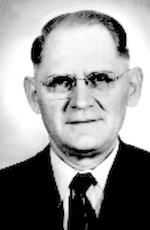
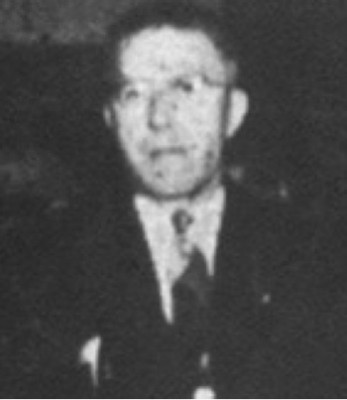
Henry Chavis

Henry Chavez was well-known to Ames residents. With his dark hair slicked straight back, large amounts of cash in his pockets, and a six-hundred-dollar diamond ring on his left hand, he was an imposing presence.

He belonged to important business and fraternal groups at the heart of the town.

But, Chavis had few friends and was not well-liked. Townspeople thought he put on airs and felt superior to them. “He was not a warm man,” a newspaper wrote after his death.

Chavis strode into Chamber of Commerce meetings, had his say, cast his vote, and left.

He conducted business with quick decisions and little conversation. He always got his money’s worth and was described by a newspaper after his death as “a brisk man with a dollar.”

Henry Chavis was popular, however, with female canning company employees. Gertrude often dropped into the factory to check out the young women and monitor her husband’s behavior.

 Courtesy photo Ames Historical Society
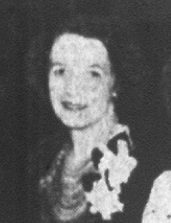
Gertrude Chavis, 1938.

Gertrude Chavis — a petite, chain-smoking, stylishly-dressed brunette — had two passions: gambling in early Mob-run Las Vegas casinos and bowling.

The Day Before the Murder

Sunday, November 7, 1948 was moderate for early November, with temperatures in the upper 40s and lower 50s. It was overcast all day. The humidity was high and snow would fall a few days later.

The Chavises were enjoying some down time. The busy canning season had ended and the harvest on their own farm was finished.

They shared lunch and then Henry dressed in his Masonic uniform, complete with a newly purchased sword, and left the house.

At 3:00 p.m. Sunday afternoon, Gertrude drove with two friends to Marshalltown, 40 miles east of Ames, for a bowling tournament.

On the way home, the ladies had a flat tire that required fixing.

Gertrude said when she returned to Ames at 9:00 p.m. Henry was not home, so she went to a movie.

Returning at 11:00 p.m., she parked her car in the garage behind the house. Seeing Henry had not yet returned, Gertrude retired to her upstairs bedroom.

At 1:30 Monday morning, a coughing fit woke Gertrude. She checked on Henry again and — assuming he was still not there — went back to bed.

Authorities said they knew where Henry Chavis spent Sunday afternoon and night, but did not make the information public.

It was leaked, however, that Chavis was in Des Moines during the day and then seen about 10:00 that night at a café on Highway 30 between Ames and Boone.

Death at the Backdoor

When Chavis returned to his farm in the early hours, he parked his 1941 Chevrolet between the house and the garage, where he usually did.

But it was not a usual homecoming. Someone had followed him or was lying in wait.

He probably saw the person in the headlights when he pulled into the driveway, because he got out of the car in a hurry, leaving his top coat on the seat and not locking the doors, as was his compulsive habit.

The waxing crescent moon cast very little light through the heavy overcast, but Chavis could see well enough to look straight at the person who meant him harm and may have even walked towards him.

As the first shot was fired, Chavis threw up his left arm to shield his face. A bullet tore through the arm and lodged in his left shoulder. Chavis spun around and was shot in the mid-back. He fell face down.

His assailant then executed him with a shot through the back of his head which exited his throat.

The killer turned the body over, took Chavis’s wallet, and disappeared.

For the rest of the night, Henry Chavis lay on the ground near a tree and two piles of sand only 12 feet from his own back door.

Gertrude Chavis said she slept soundly — hearing nothing unusual — in her second-floor bedroom, the farthest spot in the house from the murder scene.

The Morning After

About 7:00 a.m. on Monday, the Chavis’s maid Nellie Aller arrived for work in a taxicab driven by local movie projectionist “Red” Dinsmore.

Courtesy photo Jerry Litzel
Aerial view of the Chavis crime scene, taken November 8, 1948.

Aller and Dinsmore were alarmed to find Henry Chavis dead behind the house and notified Ames Police.

Patrolman Arlie Schumer reported to the scene and then sent for Chavis family physician Dr. Joe Fellows. When the doctor arrived, he asked Schumer to turn the body over and, seeing that Chavis was deceased, called for a hearse.

Courtesy photo Ames Historical Society
Henry Chavis got out of this car and was shot near a pile of sand close to the back door of his house.

When authorities went inside to notify Gertrude her husband was dead, she collapsed and had to be sedated by Dr. Fellows.

Local morticians drove Chavis’s body to Adams Funeral Home.

Law Enforcement Investigates

The Ames Police cordoned off the scene with string attached to small wooden stakes and then combed it for clues.

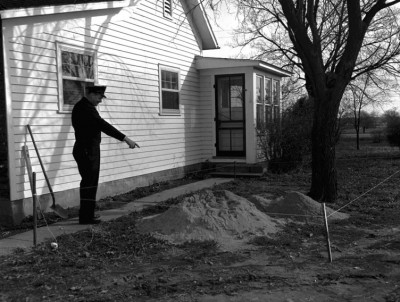
Officer Schumer spotted an empty cartridge from a .32 caliber gun and two unfired shells in a pile of sand near where Chavis fell.

Courtesy photo Ames Daily Tribune
Ames Police Officer Arlie Schumer shows where he saw the bullets.

Monday evening’s Ames Daily Tribune featured a front-page photo of Schumer at the rear of the Chavis house pointing to the spot where he spotted the bullets.

An extensive search for the murder weapon yielded nothing.

Curious spectators had already swamped the yard and house, trampling on any other evidence that might have existed.

Coroner D.G. “Guy” Mills of McCallsburg and Story County Attorney Edward J. Kelley took over the scene for Story County, whose sheriff was Gus Hall. Investigators from the Iowa Bureau of Criminal were also on hand.

Courtesy photo Iowa Department of Public Safety
D. W. “Doc” Nebergall, the “J. Edgar Hoover of Iowa.”

D.W. “Doc” Nebergall, Chief of the BCI, headed up the State’s part of the inquiry. He was known as “the J. Edgar Hoover of Iowa” and was credited with bringing scientific methods to the Bureau, even stocking its lab with his personal equipment.

Nebergall was once Story County Sheriff, so he was on familiar ground.

Doc Nebergall dug up the spent cartridge Patrolman Schumer located and took it to Des Moines for analysis.

Authorities questioned Gertrude Chavis and her daughter Doris Chavis Rehnblom. The other daughter, Loreyne Chavis Hagen, was on her way to Iowa from California.

Coroner’s Jury Meets

When BCI physician Julius Wiengart autopsied Henry Chavis on Monday afternoon at Adams Funeral Home, another bullet was discovered in his abdomen.

The bullets at the scene and the one retrieved at autopsy were from a .32 caliber automatic, the type of gun the Chavises recently reported stolen.

A coroner’s Jury of three prominent Ames businessmen met in the Council Chambers of City Hall to hear investigators’ testimony and then viewed the body at Adam’s Funeral Home.

The undertaker showed the jury Chavis’s right hand. It was bruised and the index finger broken.

The jury’s verdict was that Henry Chavis was killed “by person or persons unknown.”

Widow’s Reward

On November 30, Gertrude Chavis issued a notice in newspapers:

“[$2,500 reward for] information leading to the arrest, conviction, or affirmation by the highest appellate court of the person or persons who shot and killed my husband, Henry W. Chavis, on the early morning of November 8, 1948.”

Her offer was good only until May 30, 1949.

Lie Detector Used

Leonard Keeler examined Chavis suspects with his lie detector.

In early February 1949, Chicago resident Leonard Keeler, inventor of the lie detector machine, flew to Iowa and administered tests to ten people, including Gertrude Chavis and other family members.

Keeler said this was done “primarily to weed out suspects and to clear up rumors and verify findings.”

Whatever was learned through the lie detector tests was not made public.

Fixation on the Murder

Ames citizens obsessed over the murder, and everyone had a theory about it.

The media was preoccupied, as well, and covered the crime for months.

In September 1949, the Des Moines Tribune offered $1,000 to induce “secret witnesses” to provide information on the murder, promising total anonymity to anyone with details.

Business Deal Gone Sour?

In official speculation about the murder, the word “grudge” came up frequently.

There were dozens of people in the community who felt they got the short end of the bargain when doing business with Chavis.

An Ames Police officer told a newspaper:


“If we questioned everybody in town who has said at one time or another he would like to clip Chavis in the chin it would take months.”

Robbery?

Because Chavis’s wallet was missing, the crime looked like a robbery; but the County Attorney believed it was taken only to create that impression.

Gertrude said Henry might have had two-to-three thousand dollars on his person, part of that a $1,100 check. However, two sources claimed the check was cashed six days before the murder.

If the crime was a robbery, why was the expensive diamond ring Chavis always wore still on his hand?

To answer that, Gertrude Chavis announced to the media that her husband wore the ring for many years and could not get it off over his knuckle. He was even considering filing it off, and the undertaker had to use nippers to remove it from the body to return to her.

Something More Personal?

One official stated:

“It seems that [the] third bullet was fired by someone who had a vicious mad on for Mr. Chavis.”

That statement made the crime seem personal.

Gossip was rampant about Chavis’s love of the ladies, fueling speculation that a jealous husband murdered him.

Because his right index finger was broken and his hand bruised, it’s possible Chavis was in a fist fight earlier in the evening and someone followed him home to even the score or continue the scuffle.

Did Gertrude, tired of his philandering and — acting alone or in league with a husband Henry had wronged — shoot Henry or hire someone to kill him, promising the cash on his body as payment?

Gertrude admitted to a newspaper reporter that her marriage was less than ideal. She said she and Henry slept in separate bedrooms, went their own ways, and shared little about what they did.

Death Results in Money

In January 1949, Gertrude Chavis and her daughter Loreyne Chavis Hagen — the sole stockholders in the canning operation — sold it to the Minnesota Valley Canning Company for $100,000. The plant then operated in Ames under the Green Giant name until closing in 1957.

On February 18, 1949, twelve hundred people — many, a newspaper noted, “lured by curiosity” — attended an auction at the Chavis place to bid on agricultural equipment and household furnishings. The crowd was described as “swarming” over the farm.

Gertrude and her daughter Loreyne earned $15,000 from the sale.

A total of $115.00 was realized from the death of Henry Chavis.

Did the Mafia Murder Henry Chavis?

The Story County Sheriff’s Office believed the murder was committed by organized crime and gambling interests because Chavis recently obtained a court order to restrain Gertrude from gambling.

Las Vegas, Gertrude’s favorite gaming spot, was controlled by the Mafia in 1948. And the method of execution — two shots to the body and then one to the head — was the standard mob hit.

Perhaps Gertrude owed money to a casino and plotted to have her husband murdered — or killed him herself — to use his insurance and other assets to pay her debts.

Or was Henry’s death a message from the Mob to Gertrude?

Along the Muddy Banks of Squaw Creek

Two years after the murder, when it seemed that the investigation was cold, a chance discovery heated it up.

The Duff Avenue Bridge Courtesy photo Ames Historical Society
Henry Chavis’s gun, reported stolen to the police, was thrown off this bridge.

On April 17, 1950, two local boys — Cole Foster and Boyd Larson, both 10 — were scrambling along the banks of Squaw Creek.

The stream meanders through Ames and then flows east and under a bridge on Duff Avenue known now by locals as “Carney Bridge.”

At this spot, about a quarter mile directly north of the Chavis home, the two boys found a .32 caliber Colt automatic embedded in the mud. They turned the gun over to state authorities and hoped a reward would make them rich.

Courtesy photo Ames Daily Tribune
Cole Foster and Boyd Larson showing Boyd’s mother where they found the gun belonging to Henry Chavis

Because the gun was rusty and corroded from mud and water, authorities were not sanguine about its yielding any clues.

The ever-scientific Doc Nebergall, however, took the gun to his BCI lab and soaked it in various solutions. He raised serial numbers matching those of the .32 caliber Colt the Chavis family reported stolen before the murder.

In mid-June 1950, Nebergall fired two bullets from the gun into a five-foot-long box packed with cotton. He invited the press to watch and declared he’d never seen a gun in such bad condition fired before.

The test-fired bullets and those found at the scene and in the body were sent to an unspecified lab for comparison, but Nebergall said the results would not be released to the public.

Courtesy photo Ames Historical Society
Ivan Shalley.

Although Ivan Shalley, Story County Sheriff in 1950, announced the gun was the first real clue to the murder, the test results on the bullets were never revealed.

Still, it was Chavis’s gun. That much is known. And it would have been available to Gertrude or other family members. One of them could have taken it — causing Henry Chavis to report it as missing or stolen — and then shot him or given it to someone else to use as the murder weapon.

One of Law Enforcement’s Own?

Although everyone in Ames had a theory about the Chavis murder, the Charles Van Patter family, who lived on the farm directly south of the Chavises, had a suspect.

The Van Patters believed a member of their own family — Harry Mills, nephew of Charles Van Patter — killed Henry Chavis because Chavis was having an affair with Harry Mills’s attractive wife Veva.

Courtesy photo Des Moines Register
Former Sheriff Harry Mills, shown here after being wounded in a shoot-out, was a possible suspect in the Chavis murder.

Harry Mills served as Story County Sheriff from 1941 to 1944 and was well-known to area law enforcement, who may have been reluctant to prosecute him.

Mills became Sheriff after a 1941 shoot-out on property to the southeast of the Chavis farm.

Story County Sheriff Charles V. McGriff was gunned down while serving a commitment order on Ames Tourist Camp owner Gunner Overland. Deputy Sheriff Harry Mills was also injured in the shoot-out.

It will never be known if Harry Mills killed Henry Chavis. He died suddenly three months after the murder and his widow Veva immediately left Iowa and never returned.

Gertrude Chavis: Life Goes On

In 1950, a plat shows the Chavis farm co-owned by Gertrude, her daughter Loreyne Hagen, and her son-in-law Ralph Hagen.

The El Rancho MotelCourtesy photo Ames Historical Society
The El Rancho Motel, which Gertrude built on the Chavis property.

In 1950, Gertrude built the El Rancho Motel just south of her home, perhaps naming it after the famous early hotel and casino in Las Vegas where she gambled.

In 1967, she sold the house and farm for commercial development. The motel was razed about 35 years later.

Gertrude Chavis did not remarry after her husband’s murder. She stayed active in Ames league bowling, was an officer in the local women’s bowling organization, and was made a permanent member of the Women’s International Bowling Congress.

Gertrude died August 4, 1968 and was buried beside Henry in the Ames Cemetery.

Courtesy photo Ames Historical Society
Gertrude Chavis with a bowling trophy, 1960s.

Two months before Gertrude’s death, lightning struck the building that once housed Henry Chavis’s canning company and it burned to the ground.

The Life of Henry Chavis

Henry William Chavis was born July 24, 1893 in Benton County, Indiana, to Lizzie Grobe and William Chavis. He had a younger sister, Mary (or May) Chavis.

On October 4, 1914, he married Gertrude L. Thomas in Fowler, Indiana. The couple had two daughters, Doris Grace Rehnblom Page Ouimet and Loreyne Mae Hagen.

Chavis managed a canning company in Indiana before purchasing the one in Ames in 1936.

In Ames, he was active in Masons, Shriners, the Joshua Chapter of Ascension Commandery (Knights Templar), and Za-Ga-Zig Shrine.

He served on the Agriculture Committee of the Ames Chamber of Commerce and was President of the Iowa-Nebraska Canners Association and Director of the National Canners Association.

Chavis’s funeral was held Thursday afternoon, November 11 at First Methodist Church in Ames, and he was buried in the Oakwood section of Ames Municipal Cemetery.

Later, Gertrude was buried beside him.

Chavis gravestonePhoto by Nancy Bowers
The Henry and Gertrude Chavis gravestone at the Ames Cemetery bears a resemblance to an open book — much like the couple’s life became.
Information Needed

Questions and information about the unsolved 1948 murder of Henry William Chavis should be directed to the Story County Sheriff’s Office at 515-382-6566 or to Iowa Cold Cases through the Contact form.

Sources
  • “1,200 Attend Chavis Sale; Nets $15,000,” Council Bluffs Nonpareil, February 18, 1949.
  • “Ames Canning Co. Sold for $100,000,” Council Bluffs Nonpareil, January 19, 1949.
  • “Ames Man Killed In Own Yard: Henry Chavis, Head of Canning Firm, Is Victim of 3 Bullets,” Iowa City Press-Citizen, November 6, 1948.
  • “Auction Equipment On H. Chavis Farm,” Oelwein Daily Register,” February 19, 1949.
  • “Believe Chavis Recognized Assailant,” Burlington Hawk-Eye Gazette, November 11, 1948.
  • “Canning Factory To Start 1937 Run Early Next Week,” Ames Daily Tribune, August 4, 1937.
  • “Chavis Likely Saw His Killer Before Death,” Iowa City Press-Citizen, November 11, 1948.
  • “Chavis Murder Gun Fired, Is ‘Definitely’ Established,” Nevada Evening Journal, June 1950.
  • “Chavis Services Set For Thursday: Money and ‘Grudge’ Are Death Angles,” Ames Daily Tribune, November 10, 1948.
  • “Chavis’ Ring Not Taken as He Was Slain,” Iowa City Press-Citizen, November 10, 1948.
  • “Continue Search for Gun Used in Murder,” Ames Daily Tribune, November 9, 1948.
  • “Denies Arrest Made In Henry Chavis Case,” Cedar Rapids Gazette, July 27, 1949.
  • “Gun Found; May Be Clue In Chavis Case,” Carroll Daily Times Herald, April 18, 1950.
  • “Henry Chavis Murdered: Shot Three Times,” Ames Daily Tribune, November 8, 1948.
  • “Inspecting Gun Owned By Chavis,” Mount Pleasant News, April 18, 1950.
  • “Iowan Found Shot To Death At Farm Home,” Oelwein Daily Register, November 8, 1948.
  • “Lie Detector Tests Used In Unsolved Iowa Murder,” Nebraska State Journal, February 6, 1949.
  • Miscellaneous papers, Ames Historical Society.
  • “Mrs. Chavis, 73, died,” Ames Daily Tribune, August 5, 1968.
  • “No Tests With Chavis Weapon Until Next Week,” Ames Daily Tribune, April 22, 1950.
  • “Offer Reward For Tips Of Slaying,” Sheboygan Press, September 6, 1949.
  • Personal correspondence, Dennis C. Wendell, 2009.
  • “Question Several in Chavis Murder,” Council Bluffs Nonpareil, November 11, 1948.
  • “Ring Had to Be Clipped Off Hand Of Ames Victim,” Iowa City Press-Citizen, November 13, 1948.
  • “Says Robber Could Not Have Taken Off Chavis’ Ring,” Waterloo Sunday Courier, November 14, 1948.
  • “Still Hold Hopes Of Connecting Gun With Chavis Death,” Nevada Evening Journal, May 22, 1950.
  • “Test Shots Fired From Chavis Gun,” Ames Daily Tribune, June 16, 1950.
  • “Tests on Chavis Weapon Continue; Not Fired Yet,” Cedar Rapids Gazette, April 28, 1950.
  • “Think Chavis May Have Seen Assailant,” Mason City Globe-Gazette, November 12, 1948.
  • “Two Bullets Fired from Chavis Gun,” Cedar Rapids Gazette, June 16, 1950.
  • “Widow of Slain Ames Canner Offers Reward,” Carroll Daily Times Herald, November 30, 1948.
Tagged with:
 

Add a Comment

Leave a Reply

Your email address will not be published. Required fields are marked *

*


*

You may use these HTML tags and attributes: <a href="" title=""> <abbr title=""> <acronym title=""> <b> <blockquote cite=""> <cite> <code> <del datetime=""> <em> <i> <q cite=""> <strike> <strong>