
George Massouris (Courtesy Nonpareil)
George James Massouris
Homicide
Case Summary compiled by Jody Ewing
George James Massouris, a 30-year-old Union Pacific Railroad carman who worked part-time as a taxicab driver, was found dead in a ditch on the old Orchard Road two miles east of Council Bluffs, Iowa, on Sunday morning, Nov. 19, 1950. He’d been shot three times at the base of his skull with a .22 caliber automatic pistol.
 Pottawattamie County in Iowa
 Council Bluffs in
Pottawattamie County
Massouris, a married World War II veteran with three children, worked the part-time taxi driver job with Red Top Cab Company at nights to augment his income.
According to the Council Bluffs Nonpareil, the taxi Massouris had been driving the night of his death was found abandoned at 8 a.m. Sunday morning on Tenth Avenue, between Seventh and Eighth streets, by another taxi driver. There were no signs of a struggle.
Charles Hytrek, 44, of Star Route, discovered Massouris’ body while driving down Orchard Road to a crossroads store to get a Sunday paper. A pool of blood in the middle of the road trailed off into a ditch 25 feet away, where Massouris lay bloody but neatly clad in blue jeans, an Army shirt, and a heavy button-down sweater.
Hytrek immediately notified the Pottawattamie County Sheriff’s Office.
Officers found two empty .22 caliber shells in the taxicab and a third empty .22 caliber shell near the pool of blood.
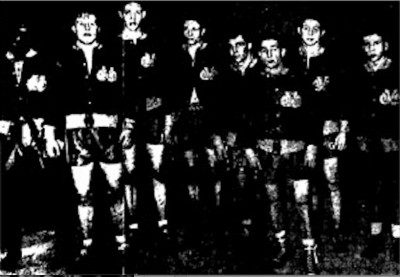
Courtesy The Council Bluffs Nonpareil
This Feb. 19, 1947 “Gloves Champions” Nonpareil photo shows Massouris, fourth from right, the Featherweight Champion of the 1947 Southwest Iowa Golden Gloves Tournament. Massouris advanced to the semi-finals in the Midwest Tournament that same year.
Coroner H. Stanley Woodring said Massouris — a former boxing Featherweight Champion — had been dead several hours before Hytrek stumbled upon the scene, the Carroll Daily Times Herald reported Monday, Nov. 20.
Massouris learned to box while serving in the Army, and after the war competed in local competitions. In 1947 he’d earned the Featherweight Champion title in the Southwest Iowa Golden Gloves Tournament and advanced to the Midwest Tournament semi-finals that same year.
Robbery Seen as Motive
The Pottawattamie County Sheriff’s Office, the Council Bluffs Police Department and the Iowa Bureau of Criminal Investigation (now the Iowa Division of Criminal Investigation) investigated Massouris’ murder and, from the beginning, believed robbery was the motive.
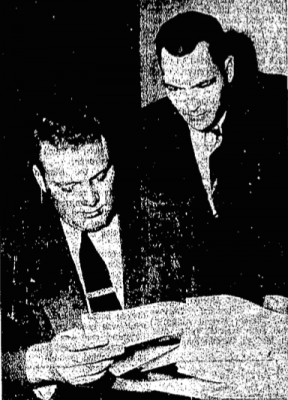 Courtesy photo Council Bluffs Daily Nonpareil
Detectives Leon Nelson and William Swassing sift through some the Massouris files in November 1952 as the unsolved murder heads into its third year.
Massouris’ billfold — containing only $8 or $9 — and his evening fares were missing, though the robber hadn’t bothered to steal Massouris’ wristwatch.
Massouris’ employer, Don Wilson, said Massouris answered a call to the intersection of Scott and Mynster streets shortly after 9 p.m.
Another cab driver, Don Haines, said he was on his way home from work at 11:30 and noticed Massouris’ cab parked on Tenth avenue between Seventh and Eighth streets, the Gazette reported November 20.
Grace Goodno, a dispatcher for the cab company, told officials a call was logged at 7:45 p.m. Saturday requesting a taxi be sent to the First Christian Church, Scott and Mynster Street, at 9 p.m. sharp. Goodno said Massouris pulled into the cab office at 9:08 p.m. and drew the assignment to pick up the mysterious passenger just two blocks away.
It was the last time anyone saw Massouris alive, although Mr. and Mrs. Thomas Capel, who lived near the murder scene, told the Nonpareil they’d seen a taxicab pass their home around 9:30 p.m. Saturday before they’d headed back toward Council Bluffs.
When other Red Top Cab Company drivers found the cab still parked there Sunday morning, they took the cab back to the office. Unaware of Massouris’ murder, taxi company officials put the cab back into service, and several passengers rode in it before news of Massouris’ death was reported an hour later, eliminating any chance of collecting latent fingerprints on the door handles or steering wheel.
Searching for a Suspect
On Wednesday, November 22 — just three days after Massouris was found dead — Council Bluffs police announced that a 17-year-old Council Bluffs youth had been arrested in Denver, and that police were interested in questioning the youth about connections he may have had in the Massouris slaying. The youth in Denver had been accused of stealing a car the same night of Massouris’ shooting, but nothing ever came of the lead.
Investigators questioned hundreds of people, but even tipsters with “hot leads” led nowhere.
FBI ballistics experts and the State Bureau of Investigation worked on the three bullets and on the three brass shell casings found in Massouris’ taxi.
“We still are investigating — still questioning,” Council Bluffs Police Chief Earl Miller is quoted as saying in a November 9, 1952, Nonpareil story. “While there’s nothing new about the phrase, it’s still true — murder will out.”
On November 15, 1953, the Council Bluffs Nonpareil reported the Massouris case had entered into its fourth year and that the “Police File Grows On Baffling Murder.” The article cited the “bad break” police had after learning Massouris’ taxi had immediately been put back into service before his body was found and before officials had time to search the vehicle.
About George Massouris
George James Massouris was born Oct. 29, 1920, in Britt, Iowa, to James and Margaret (Hinkle) Massouris.
He married Helen Rose Emmons Aug. 19, 1939, in Council Bluffs, Iowa, and the couple had three children.
On June 26, 1944, George enlisted in the US Army for the duration of World War II.
Massouris learned to box while serving in the Army, and after the war competed in local competitions. In 1947 he earned the Featherweight Champion title in the Southwest Iowa Golden Gloves Tournament and advanced to the Midwest Tournament semi-finals that same year.
George was employed as a carman with the Union Pacific Railroad shops in Omaha, and worked part-time for Red Top Cab Company as a taxi driver.
Funeral services were held Monday, November 20, 1950, and George Massouris was buried in Council Bluffs, Iowa.
Information Needed
George Massouris’ unsolved murder is under the jurisdiction of the Pottawattamie County Sheriff’s Office. If you have any information about this case, please call (712) 890-2200.
Sources:
- Council Bluffs Police Department
- Pottawattamie County Sheriff’s Office
- Iowa Division of Criminal Investigation
- Correspondence with Det. Steve Andrews (Council Bluffs Police Department), May 2013
- Correspondence with Capt. Dwayne Riche (Pottawattamie County Sheriff’s Office), May 2013
- “Investigations continue in unsolved murder cases,” by Courtney Brummer, The Daily Nonpareil, August 18, 2003
- “Taxi Driver Memoriam List,” taxi-library.org
- “Five Iowa Murders Are Still Unsolved,” The Estherville Daily News, Monday, October 13, 1958
- “Authorities Seek New Clues — Unsolved Iowa Murders,” by the Iowa Daily Press Association, The Carroll Daily Times Herald, Friday, October 10, 1958
- “Massouris Case Into Fourth Year: Police File Grows On Baffling Murder,” The Council Bluffs Nonpareil, November 15, 1953
- “Murder 2 Years Ago Still Under Investigation,” The Cedar Rapids Gazette, Page 10, Tuesday, November 11, 1952
- “Murder of George Massouris in 1950 Is Still Unsolved — But Not Forgotten,” The Council Bluffs Nonpareil, November 9, 1952
- George James Massouris (1920 – 1950) — Find a Grave Memorial
- “Ancestral File,” The Church of Jesus Christ of Latter-day Saints, database, FamilySearch.org, entry for George James MASSOURIS.
- “Find A Grave Index,” database, FamilySearch, George James Massouris, 1950; Burial; citing record ID 129623743, Find a Grave, https://www.findagrave.com/.
- “Around Iowa: Murder Suspect?” The Cedar Rapids Gazette, Page 14, Wednesday, November 22, 1950
- “Slain Taxicab Driver Husband of Former Carroll Girl,” The Carroll Daily Times Herald, Tuesday, November 21, 1950
- “Taxicab Driver Shot to Death,” AP/The Cedar Rapids Gazette, Monday, November 20, 1950
- “Bluffs Taxi Driver Found Slain in Ditch,” The Carroll Daily Times Herald, Monday, November 20, 1950
- “Gloves Champions,” The Council Bluffs Nonpareil, February 19, 1947
- “United States World War II Army Enlistment Records, 1938-1946,” database, FamilySearch, George J Massouris, enlisted 26 Jun 1944, Cp Dodge, Herrold, Iowa, United States; citing “Electronic Army Serial Number Merged File, ca. 1938-1946,” database, The National Archives: Access to Archival Databases (AAD) https://aad.archives.gov/aad/index.jsp : National Archives and Records Administration, 2002); NARA NAID 126323, National Archives at College Park, Maryland.
- “United States Census, 1930,” database with images, FamilySearch, Helen R Emmons in entry for Franklin B Emmons, 1930.


At one point this entry mentioned a fare Mr. Massouris was to have picked up at a rough old honky tonk bar that was under the viaduct. I believe a waitress was wating for it and you alluded to the fact she had something to do with it. Now all that is deleted. I wish I could remember the name of that bar because my mother told me how rough it was. I think it was called Ranchero or something similar.
I NEW MR. MASSOURIS, I WENT TO SCHOOL WITH HIS DAUGHTER, SALLY.WAS IN THE HOME AFTER SCHOOL, MR. MASSOURIS ALWAYS GAVE THE KID’S O THE NEIGHBOR HOOD MONEY ,FOR POP SICKLES. HE ALWAY’S SEEMED LARGER THAN LIFE, SORTA, LIKE (AL PACINO)’ MAY THE HOLY SPIRIT BLESS YOU NOW AND FOREVER. EVE( MILLER ) MC BRIDE
It’s sad that he served his country and someone thought it was a good idea yo rob and then kill him. It would be interesting to know if the evidence is still around. Also, if the shell casings could be connected to another crime.
Recently, a guy in jail in another state for a crime, was tied by DNA to a similar murder in adjoining state, which took place in 1984.
I just can’t get over the number of Iowa cold cases. It’s great that they get at least some interest on Facebook. I wish more would get solved though. Some of the cases are so sad!
So sorry.
Still can’t get link to link.
Never far from my thoughts.
To Phil and James, I lived next door to you when this horrible thing happened. I still think about you guys and Sally every now and then. I’m so sorry – I heard about Sally. My name was Jackie Rhoten and is now Jackie Porter. I was closer in age to James (Corky) and i’m sure he remembers my family.